

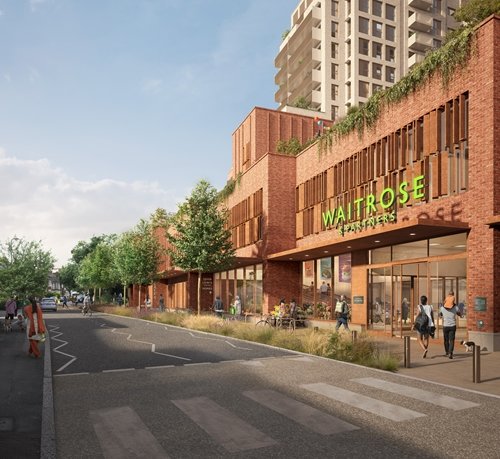

The West Ealing site sits on Alexandria Road, just 100 metres from West Ealing Station on the Elizabeth Line. This gives it a Public Transport Accessibility score of 4/5 – one of the highest in the Borough – with fast links into central London and Heathrow, plus excellent local bus and road connections. The location is ideally placed for sustainable, car-free living.

The story so far:
In May 2025, planning permission was granted for the transformation of the West Ealing Waitrose store into a new neighbourhood of 428 build to rent homes, a modern supermarket, landscaped public spaces and community amenities.
You can read the Government Inspector’s full report on the project here.
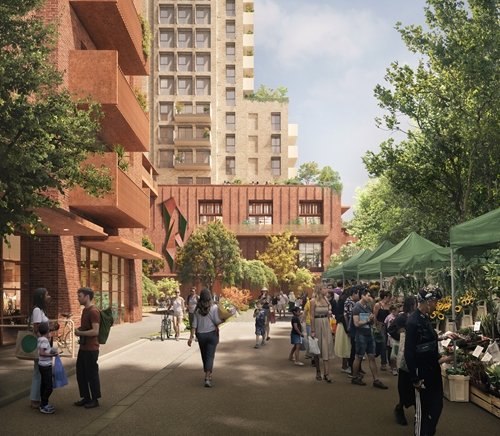
The site sits at the heart of West Ealing Metropolitan Town Centre, directly beside the Elizabeth Line Station, and offers one of the most sustainable brownfield opportunities in London. The development is about more than new homes: it replaces a car-dominated site with high-quality housing, shared gardens and a new civic square. It also builds on Waitrose’s role as a retail anchor, ensuring the town centre remains vibrant and fulfills the local community needs, while meeting local housing needs.
By combining JLP’s ethos of service and long-term stewardship with design by award-winning architects Lifschutz Davidson Sandilands, the scheme demonstrates how housing delivery and good architecture can be reconciled in a way that benefits the local community, the Council, and future residents.

Why build to rent?
Ealing has a pressing need for significantly more housing. The Draft Ealing Local Plan seeks to provide 2,157 homes per year, however we expect this to increase to approx 3,407 homes per annum in line with the requirements of the NPPF (December 2024). An important part of this is delivering new high quality rental housing. The scheme directly addresses this shortage, adding 428 new homes of which at least 83 will be affordable.
Build to rent is especially suited to the needs of West Ealing. It offers well-managed, secure rental housing with long tenancies, inclusive services and no hidden charges. This stability allows residents to put down roots, while the homes remain accessible to a broad mix of households. The model responds to London’s growing demand for high-quality rental housing and strengthens the community fabric, by repurposing underused sites such as supermarket car parks.